From MVP › MVB › Building Maximal Viable Brands
MxVBs
Brand-led value creation: Brand building as a multiple expansion lever and firewall against competition.
MxVB©-facts:
90% of S&P 500 market value are intangible assets.
70% of stock return impact attributable to brand equity.
9× higher volume share for high demand brands.
Why Not Minimal?

The Minimal-Moving Trap.
Scale-ups are running the most important brand-building phase of their lifecycle with processes designed for seed-stage companies.
In constantly transforming markets, minimal thinking - like Minimal-Viable-Product (MVP), or incremental Minimal-Viable-Brand (MVB) re-positions - creates vulnerability, confusion and limited growth.
You can pivot a product in a sprint. You cannot pivot perception of future audiences in a quarter. The window to define your category and destinct role as a brand closes faster than you think. And AI can replicate product features in weeks, while your brand position takes years to erode.
Maximal Viable Brand (MxVB©) creates this strategic resilience and value - a clear brand position that can flex and evolve while maintaining coherent equity. You're maximizing your ability to transform with intention rather than inventing with minimal responses.
The strongest possible brand foundation that your resources allow, with the most future claim you can own. Because brand perception is the ultimate currency for markets and next investment-rounds - hard to ignor, or to change, value and margin driving over time.
What Gap to Close?
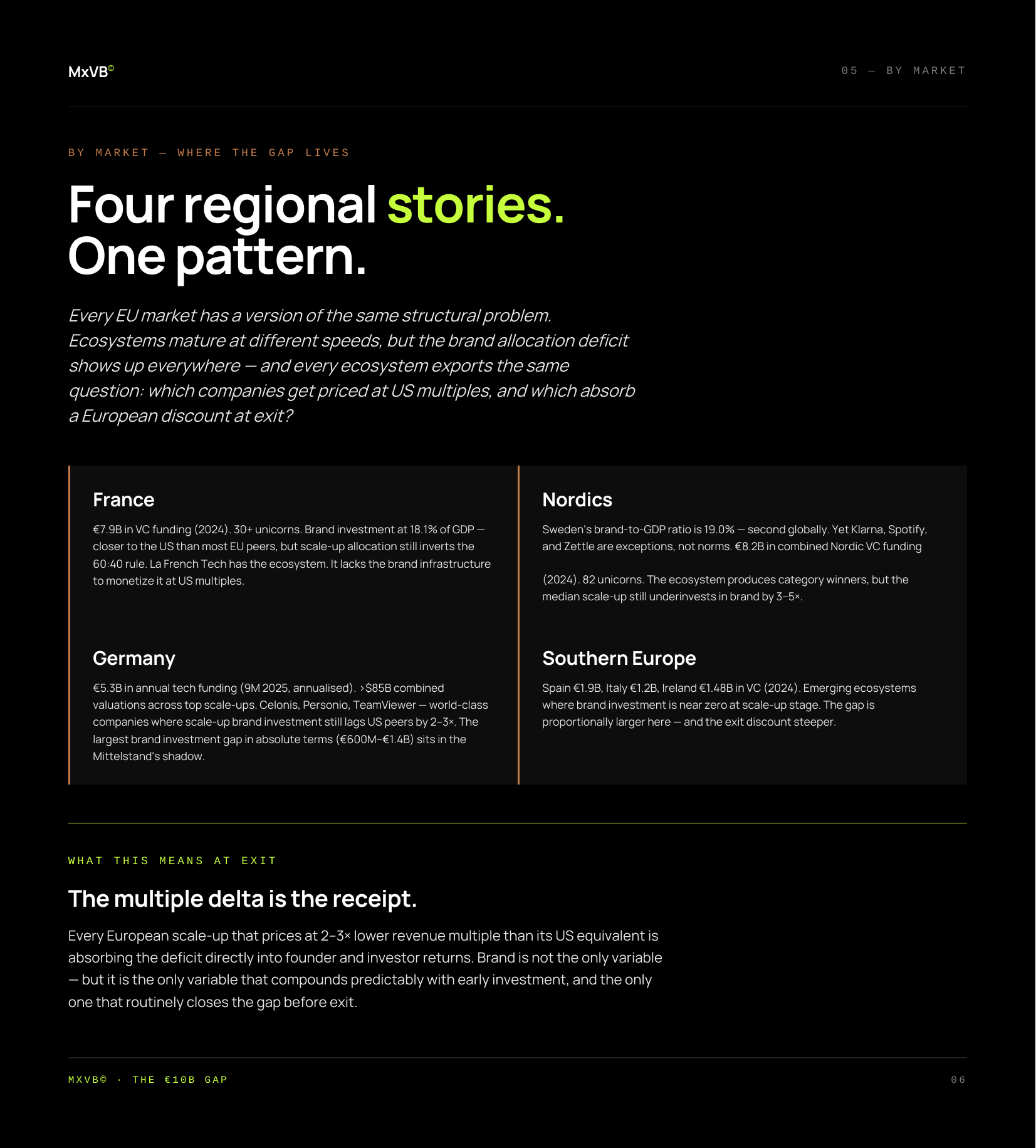
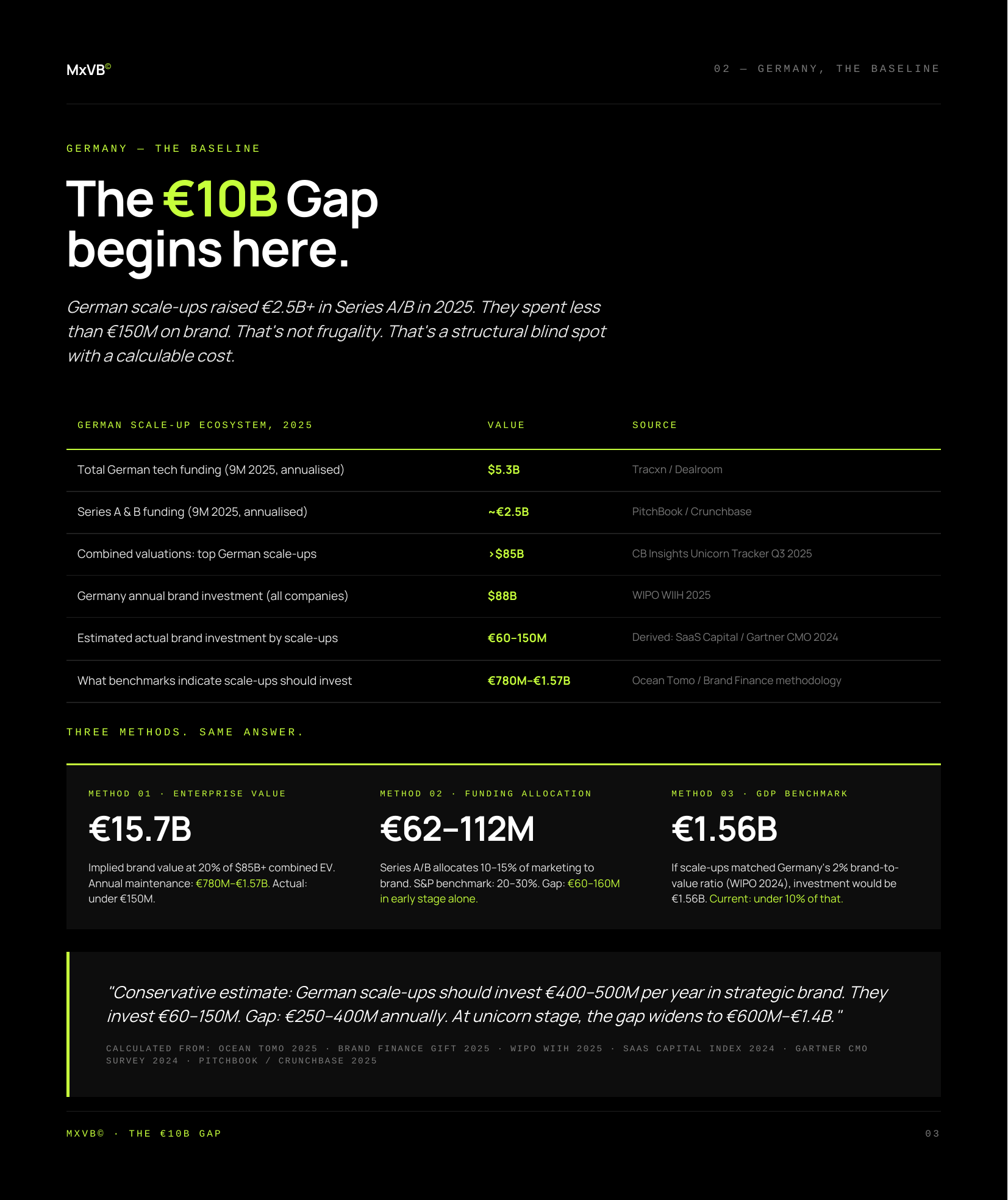
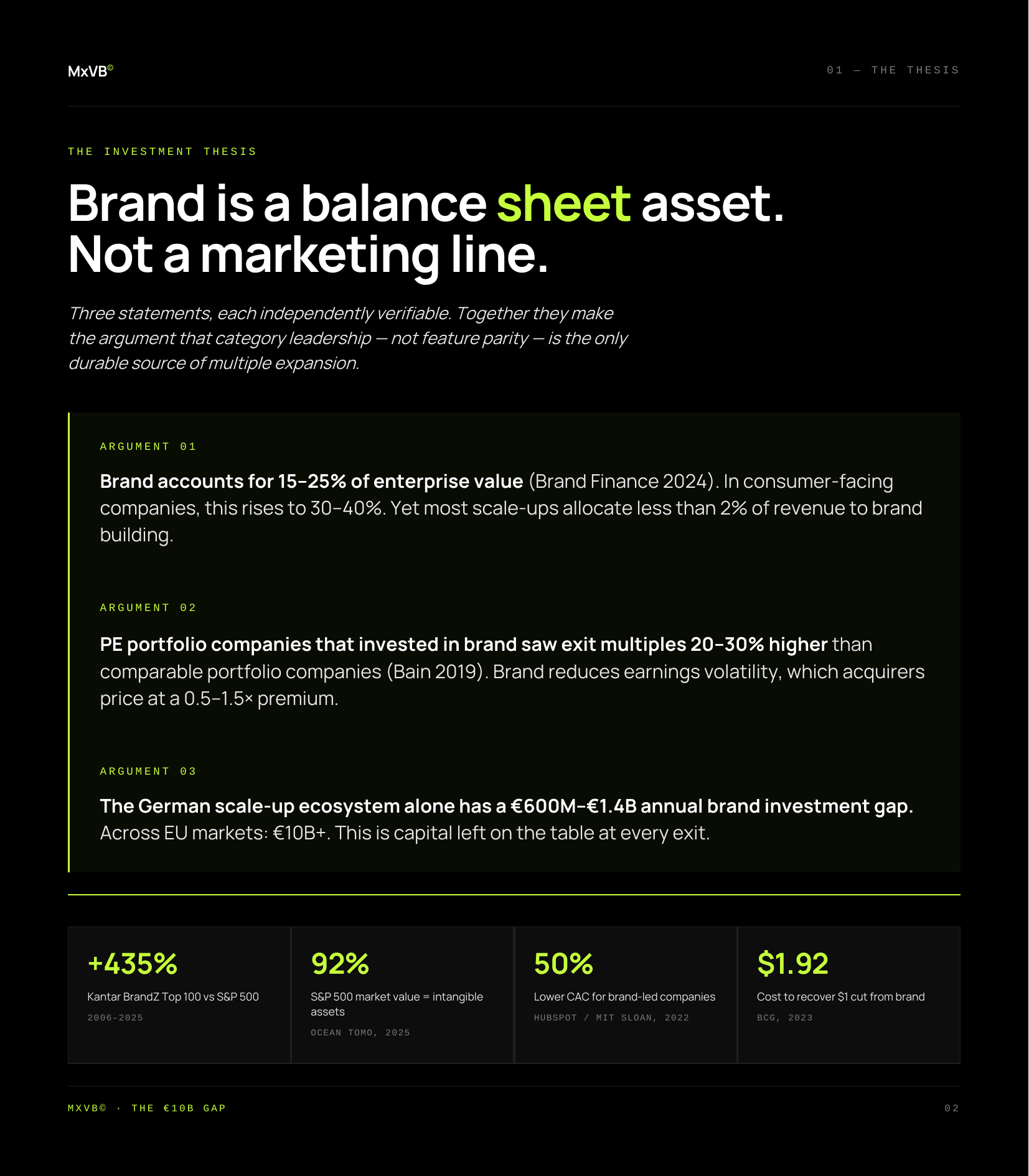
The Math behind the Strategic Mistake - a Snapshot:
Brand equity contribution to enterprise value:
#
Financial Services: 10–20%
#
Consumer Goods: 25–40%
#
Technology: 20–30%
#
Healthcare: 10–25%
#
Mass Production: 5–15%
# Financial Services: 10–20% # Consumer Goods: 25–40% # Technology: 20–30% # Healthcare: 10–25% # Mass Production: 5–15%
Why it Matters for Scale-Ups?

The Series-B Brand Crisis.
You've achieved product-market fit. Now comes the paradox: you need to 10x revenue, but your brand was not built for it. Your competitors just raised nine figures and they're spending on category creation and future demand while you're still explaining what your product does in three different ways.
Minimum viable brand thinking worked when you were testing product-hypotheses. It fails when you're scaling conviction to enter the next round of growth and investment.
In scale-up markets, second place is first loser. You either own the narrative or rent attention from whoever does. While you're iterating your positioning, someone else is maximizing theirs - defining an unseen category, the language, occupying mental territory, establishing the reference points that shape how markets and investors evaluate all entrants.
Maximum viable brand (MxVBs©) thinking transforms product-founder-led equity into a market-position-led architecture. It's positioning that supports investment closures, secures premium pricing, narratives that attract top talent, and strategic clarity that scales across and into new markets without diluting meaning.
MxVB builds brand architecture as a balance sheet asset - engineered for category ownership, pricing defensibility, and investor-grade measurable outcomes.
Build the brands the market couldn't imagine replacing.

FAQs: What Founders & PEs often have in Mind:
-
Every founder believes this. And for 12–18 months, they're right. Product-led growth without brand architecture is a temporary advantage with an expiration date. Ehrenberg-Bass data shows only 17% of buyers in major categories see a product as genuinely different.
-
We are trained to build category-defining brands in multi-market setups building brands for companies worth $10B+. Delivering bluechip-company thinking compressed into scale-up speed. Scale-ups should not run the brand-building phase with seed-stage tools.
-
Repositioning costs 3-5x more than positioning. By Series C, your competitor has already defined the category language. You're not building brand - you're buying it back. Every quarter you wait, the cost goes up and the impact goes down.
-
Scale-ups that rely exclusively on performance marketing face a demand exhaustion - CPAs start climbing because they've harvested all existing demand without generating new future demand. When that demand runs out, the cost base explodes.
-
We measure it the way investors do: CAC reduction, revenue multiple expansion, brand predisposition scores, and category vocabulary share. MxVB© engagements includes a measurement baseline so you can track impact quarter over quarter.
-
A designer builds what you tell them to. MxVB© tells you what to build and why - backed by quant data from real buying audiences. The identity system is one deliverable. The category claim that makes it defensible is the real producthip.
-
You know your product and your current users. You don't know how non-buyers categorize you - or whether they categorize you at all. Internal teams optimize from the inside out. MxVB© builds from the buyer's mental model inward.
-
They're asking for lower CAC, higher retention, and a path to category leadership. That is brand - they just don't call it that. Data shows strong brand portfolios outperform the S&P 500 by 2x. Your investors want brand. They want the P&L outcome of it.